Key Takeaways
- Gamification fosters consistent learning by turning training into a repeatable habit rather than a one-time event.
- Microlearning and short, streamlined sessions help employees sustain engagement in busy work environments.
- Social features, role-based personalization, and small, meaningful goals keep motivation high.
- Measuring frequency, spacing, retention, and real on-the-job behavior shifts is crucial for long-term success.
Table of contents
- The Problem: Why Learning Habits Break In The Workplace
- How Habits Form (In a Corporate Context)
- Where Gamification Fits In
- Gamification Mechanics That Build Consistency
- Designing Gamified Learning Systems for Different Roles
- Making Learning Social
- Aligning Gamification With Business Outcomes
- Measuring Habit Formation
- Implementation Steps
- Conclusion – Building a Sustainable Culture of Continuous Learning
- FAQ
The Problem: Why Learning Habits Break In The Workplace
Most employees start training with good intentions. The habit breaks when the work environment makes repeated learning hard.
Here are the biggest reasons consistency falls apart.
1) Time constraints and fragmented attention
Workdays are full of meetings, messages, and urgent tasks. That creates two problems:
- People don’t have a clear time “slot” for learning.
- Even if they do, they’re tired from switching between tasks.
Long courses and heavy modules require more focus than most people can give during a normal workday. That doesn’t mean your content is bad. It means the format fights reality.
If your goal is corporate training engagement, you have to design for short attention windows-not ideal ones. For a deeper look at why bite-sized formats work so well, see why interactive microlearning is the future of employee upskilling.
2) Low perceived relevance (the “this isn’t for me” problem)
When training feels generic, employees treat it like compliance. Motivation drops fast when learners don’t feel:
- Autonomy (I have choice and control)
- Competence (I can improve and see progress)
- Relatedness (this connects to my team and my goals)
These needs are often missed when everyone gets the same training, in the same order, at the same difficulty.
3) Lack of reinforcement (no payoff today)
Learning often has a delayed reward. You study now, but you might use it weeks later.
Without reinforcement, people stop showing up. There’s no immediate sign that today’s learning mattered.
This is the gap that learning habit formation gamification is meant to close. The issue isn’t just motivation-it’s missing feedback, missing progress, and missing reasons to repeat.
Key point: good content is not enough. If the environment doesn’t support repetition, habit formation fails.
If you’re exploring practical ways to build consistency into training, this overview of gamification approaches for training and development is a helpful starting point.
How Habits Form (In a Corporate Context)
To build consistent learning, it helps to understand how habits work at work-not in theory, but in real daily routines.
The cue → routine → reward loop (workplace version)
A habit forms when three parts repeat in the same order:
- Cue: a trigger to start (calendar block, notification, manager prompt, end-of-shift routine)
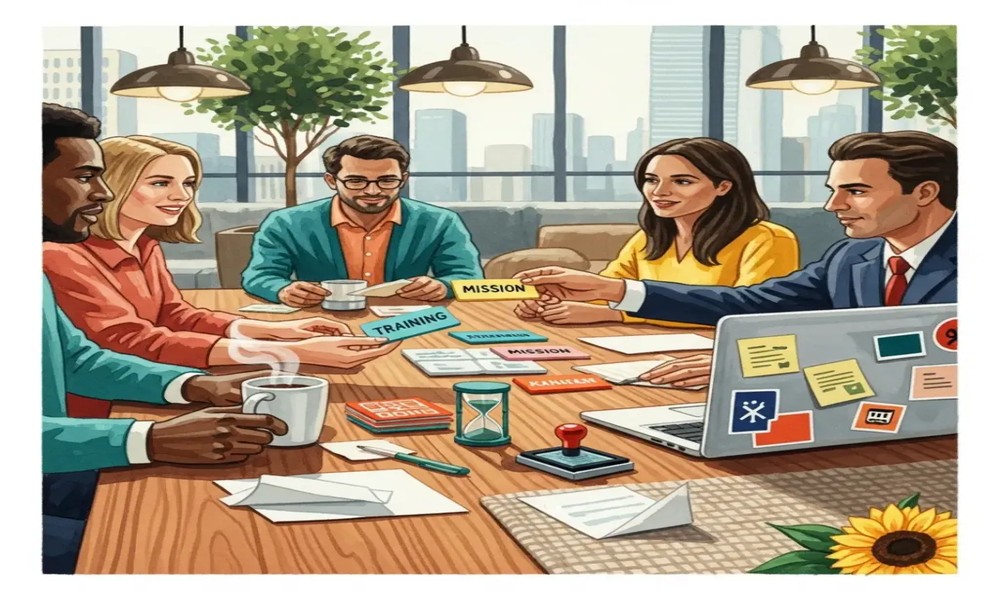
- Routine: the action (2-5 minute mission, quick scenario question, short reflection)
- Reward: something immediate (feedback, progress bar, points, recognition, “level up,” streak saved)
Most corporate training has the routine (content), but it often lacks a reliable cue and an immediate reward.
Why small actions beat big sessions
Companies often design training like this:
- “Finish this 45-minute module.”
- “Complete this course by Friday.”
That can work once. It rarely builds a habit.
Habits are built through small actions that feel easy to start. The easier it is to begin, the more often employees repeat it. Repetition is what creates change.
This is where gamification for employee learning connects directly to learning habit formation gamification: it helps you design the cue, the routine, and the reward so the loop actually repeats.
How these mechanics work together
Think of mechanics like tools in a system. A single mechanic rarely builds a habit. A set of mechanics can.
A strong combination for consistency often looks like:
- daily mission + streak + micro-goal + quick feedback
That is how learning habit formation gamification becomes real behavior-not just a design idea.
Reinforcement Strategies
Reinforcement is the “glue” that makes habits stick. Without it, engagement fades after week one.
Nudges (prompts that reduce friction)
A prompt only works when the action is easy. If a reminder sends someone to a 30-minute module during a busy shift, it won’t help.
Good nudges are:
- timed to the workday,
- short and actionable,
- tied to a clear next step (“Do today’s 3-minute mission”).
Spaced repetition (review at the right time)
Learning fades quickly when it’s not revisited. Spacing helps by revisiting key concepts over time.
In gamified learning systems, spaced repetition can be built into:
- daily review questions,
- weekly “boss battles” (challenge quizzes),
- mission rotations that bring back critical topics.
Daily missions (the micro-action engine)
Daily missions are the simplest way to keep training alive.
Good missions are:
- 2-5 minutes,
- tied to real job moments,
- focused on practice, not just reading.
This is the heart of many training gamification programs because it creates a repeatable rhythm employees can follow.
Designing Gamified Learning Systems for Different Roles
A habit sticks faster when the learner thinks: “This helps me today.”
That’s why role relevance is not a “nice-to-have.” It’s a core requirement.
Personalization through role-based pathways
Role-based pathways make training feel targeted:
- “New Supervisor Foundations”
- “Sales Discovery Skills”
- “Warehouse Safety Lead Track”
- “Customer Support Escalation Practice”
When employees see a path built for their job, corporate training engagement rises because the content answers a real need.
Difficulty scaling (start easy, then build)
Habit formation needs early wins.
If the first missions are too hard, people drop off. A better approach:
- start with simple tasks to build routine,
- then increase challenge as confidence grows.
This supports long-term growth and makes progression feel fair.
Choice within structure (autonomy without chaos)
Autonomy matters. But companies also need core skills covered.
A good compromise:
- required core missions (must-do skills)
- optional missions (choose based on interest or role needs)
This blends structure and choice-two important parts of strong employee development strategies.
If you’re thinking about building this kind of system (not just adding a few game elements), these game-based learning and gamification solutions show how role pathways, progression, and mission design can work together.
Making Learning Social
Social energy is one of the fastest ways to make learning feel normal.
When learning becomes a team behavior, not a solo task, it is easier to sustain.
Team challenges (build group consistency)
Team challenges help departments build a shared routine:
- “Every team member completes 3 missions this week.”
- “Support team hits a 90% streak rate for 2 weeks.”
This works because it builds a social norm: “We do this here.”
Peer challenges (small, friendly competition)
Peer challenges work best in small groups where people know each other.
Examples:
- quick scenario battles
- timed quizzes (short and low-stakes)
- cooperative missions (“solve this case together”)
Keep it friendly. The goal is consistency, not pressure.
Mentorship loops (support + recognition)
Mentors can make gamified learning feel more human:
- mentors assign missions,
- review outcomes,
- give short feedback,
- recognize improvement.
This is especially powerful for new hires and new managers.
Recognition that rewards effort, not just top scores
If you only recognize the top 3 people, everyone else checks out.
Better recognition options:
- “most improved”
- “consistent learner”
- “helped a teammate”
- “quality streak” (streak + high accuracy)
This keeps social mechanics supportive and fair-key to sustainable employee development strategies. If you want a practical framework for balancing competitiveness with team momentum, explore how to balance competition and collaboration in gamified corporate learning.
Aligning Gamification With Business Outcomes
Gamification should never be “engagement theater.” If it doesn’t improve real performance, it won’t survive leadership review.
To align training gamification programs with business outcomes, connect game actions to job actions.
Map missions to role-based competencies
Start by listing the skills that matter:
- safety checks
- compliance steps
- sales behaviors
- customer empathy skills
- product knowledge
- leadership habits
Then build missions that practice those skills.
Use job-task-like missions (practice, not just content)
Many companies focus on content consumption. But behavior changes through practice.
Strong missions look like:
- scenarios with realistic choices
- simulations of conversations
- decision trees (“what do you do next?”)
- short reflections tied to today’s work
This is where gamified learning systems beat basic LMS training: they can make practice repeatable and trackable. For more on how scenario practice improves real decisions, see scenario-based learning games: the secret to better decision-making at work.
Reinforce performance support behaviors
Some of the most important workplace behaviors are “support behaviors,” like:
- using SOPs,
- following checklists,
- completing quality steps,
- documenting correctly.
You can gamify these behaviors by:
- rewarding correct process use,
- tracking consistency,
- recognizing teams that reduce errors.
Engagement layer vs full system
Be clear about what you’re building:
- Lightweight layer: points/badges added to an LMS course
- Full gamified learning system: missions, pathways, progression, social loops, and analytics tied to performance
Both can help. But only the full system usually builds strong long-term habits.
Measuring Habit Formation
If you want habit formation, you must measure habit signals-not just completion rates.
Here are practical measures that show whether learning is becoming routine.
1) Participation frequency
Track how often employees show up:
- active learning days per week
- missions completed per week
- percent of learners hitting the weekly micro-goal
This is your core corporate training engagement metric for habit building. For a broader set of measurement ideas (beyond completion), review key metrics for gamification success in corporate training.
2) Completion cadence (the rhythm of learning)
Look at spacing between sessions:
- Do people learn every day?
- Do they binge once per month?
- Where do streaks break?
- What week do drop-offs happen?
Cadence tells you whether the habit loop is working.
3) Knowledge retention over time
If learning is sticking, employees should remember more weeks later-not just right after the module.
Use:
- low-stakes quizzes,
- short scenario checks,
- periodic review missions.
This also helps you improve the content, not just the engagement.
4) On-the-job behavior change
Training is only valuable if it shows up in work.
Ways to measure transfer:
- manager observation checklists
- quality metrics (error rate, rework, compliance issues)
- time-to-proficiency for new hires
- customer satisfaction signals
This is where employee development strategies prove real business value.
Implementation Steps
Building consistent learning habits is not a one-week launch. Treat it like a product rollout: test, learn, improve.
Here’s a practical roadmap for gamification for employee learning that focuses on habit formation.
1) Audit content (turn big training into micro-missions)
Start by breaking training into small actions:
- 2-5 minute missions
- short scenarios
- quick check questions
- weekly review challenges
Choose topics that matter most to performance.
2) Define metrics before launch
- “3 learning days per week per employee”
- “80% of learners maintain a 2-week streak”
- “+15% quiz retention at 30 days”
- “reduced mistakes in a key process”
If you don’t define success early, you’ll end up measuring only clicks.
3) Design the core loop (cue → routine → reward)
Write down the habit loop:
- Cue: When will the prompt happen? (time, workflow event, manager moment)
- Routine: What is the tiny action?
- Reward: What feedback, progress, or recognition happens immediately?
Only add mechanics that strengthen this loop. Don’t add features just because they look fun.
4) Pilot with one role group for 6-10 weeks
Pick a group with:
- a clear skill need,
- supportive managers,
- a realistic workload.
A pilot should be long enough to see patterns. Week-one excitement is not habit formation.
5) Iterate using real behavior data
Use pilot results to fix friction points:
- missions too long?
- prompts poorly timed?
- rewards meaningless?
- leaderboards discouraging some learners?
- pathways unclear?
Refine and test again.
6) Scale with governance (keep it fair and meaningful)
When scaling training gamification programs, you need rules:
- how points are earned
- what badges mean
- how to prevent “gaming the system”
- how often content is updated
- how managers validate real-world skills
If you want support designing and scaling this beyond a simple add-on, you can explore these game-based learning and gamification solutions as a next step for system-level adoption.
Conclusion – Building a Sustainable Culture of Continuous Learning
Consistent learning at work is not about willpower. It’s about design.
When gamification for employee learning is done well, it creates the structure that habits need:
- clear cues,
- tiny repeatable routines,
- immediate rewards,
- visible progress,
- and social support that keeps learning normal.
That is the real promise of learning habit formation: not flashy points, but a system that helps employees practice skills often enough for the skills to stick.
If your organization wants to build richer interactive training experiences (like simulations and mission-based learning), working with a Unity game development company can support more advanced builds that connect learning, practice, and performance in one experience.
FAQ
What is gamification for employee learning?
Gamification for employee learning involves applying game mechanics-like cues, feedback loops, and small rewards-to help employees develop consistent, repeatable learning habits. It makes training more engaging, easy to start, and rewarding to continue.
How does gamification help build learning habits?
Gamification supports the cue → routine → reward loop by providing triggers (daily missions or reminders), short and manageable learning routines (microlearning tasks), and immediate rewards (points, progress bars, feedback). These elements encourage frequent, repeatable actions that form habits.
What are the main metrics to measure gamification success?
Key metrics go beyond completion rates and include frequency of participation, learning cadence, knowledge retention over time, on-the-job behavior changes, and qualitative feedback. These measurements show whether training is truly becoming a habit.